OVERVIEW
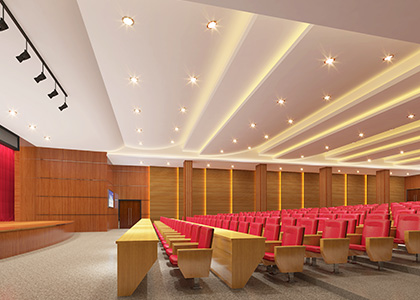
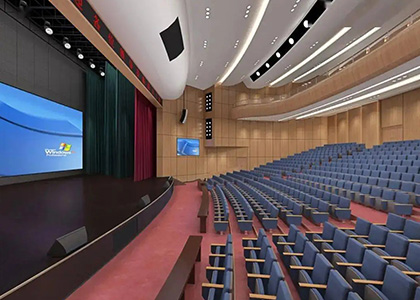
This report focuses on the second phase of the Shenzhen Masefield Industrial Park runway. The design drawings used for this sound quality simulation are the December 2018 version of the architectural design drawings and related building models, aimed at verifying the sound field situation in the undecorated situation and exploring acoustic solutions, and providing acoustic suggestions for the next step of indoor design.
Show Sound Quality Design Indicators
Reverberation time design indicators
As a multifunctional hall in this project, the runway mainly meets the functions of fashion shows, conferences, news releases, and product exhibitions. Based on this positioning, referring to the current "Code for Acoustic Design of Theaters, Cinemas, and Multipurpose Hall Buildings" (GB/T50356-2005) and "Code for Design of Theater Buildings" (JGJ57-2016), the selection of full reverberation time (80% audience) in the audience hall should comply with the following regulations:
A.When the frequency is between 500 and 1000Hz, the appropriate reverberation time for different volumes of multi-purpose halls should be selected within the range shown in Figure 1:
 The range of suitable reverberation time T for auditoriums with different volumes of V in the auditorium, lecture hall, and multi-purpose auditorium at 500-1000Hz.
Explanation: The shaded area represents the range of values for reverberation time; A tolerance range of ±10% is allowed between the estimated design value and the measured value after completion.
B.According to the standard "Code for Acoustic Design of Theaters, Cinemas, and Multipurpose Hall Buildings" (GB/T50356-2005) and "Code for Design of Theater Buildings" (JGJ57-2016), the frequency characteristics of the reverberation time should be in accordance with the following table:
The ratio of reverberation time at various frequencies relative to 500-1000Hz in the auditorium, lecture hall, and multi-purpose auditorium.
|
Conditions of Use
|
125
|
250
|
2000
|
4000
|
|
Hall, lecture hall, and multi-purpose auditorium
|
1.0~1.3
|
1.0~1.15
|
0.9~1.0
|
0.8~1.0
|
The indoor volume of this show is approximately 16669m ³, Considering that the number of people in the show varies greatly under different usage functions, based on the above design principles, the design values for reverberation time in the open space conditions of the theater audience hall are determined as follows:
Design indicators for reverberation time in show/open spaces
|
Frequency(Hz)
|
125
|
250
|
500
|
1000
|
2000
|
4000
|
|
Design value of reverberation time(T/s)
|
1.60~2.08
|
1.60~1.84
|
1.60
|
1.60
|
1.44~1.60
|
1.28~1.60
|
|
Characteristic ratio
|
1.0~1.3
|
1.0~1.15
|
1:1
|
4:1
|
0.90~1.00
|
0.80~1.00
|
Design reference values for other sound quality parameters on the runway
|
Sound quality parameter name
|
Design reference value
|
|
Definition
|
≥50%
|
|
Center of gravity time
|
60~80ms
|
|
Sound field normniformity
|
6dB
|
|
Language Transmission Index
|
≥0.5
|
Preparation for Sound Quality Computer Simulation
Overview of simulation software
The computer simulation of sound field is based on the established spatial geometric model, using digital simulation methods based on geometric acoustics to simulate the propagation of sound lines in the hall, conducting detailed computer acoustic simulation analysis of the space, and obtaining an acoustic design method for indoor acoustic characteristics.
The acoustic simulation software ODEON used in this project. ODEON software uses both sound source method and line tracing methods for comprehensive calculation, and uses Lambert scattering algorithm to calculate the diffusion of sound, making the simulation process more realistic and the calculated results closer to the measured values. It is recognized as one of the most reliable building acoustic simulation software in the world. The steps for conducting indoor sound quality simulation are as follows:
1. Establishing a three-dimensional building model of the actual hall should comply with the corresponding requirements of ODEON software.
2. Establish an acoustic 3D model by arranging sound materials on all surfaces of the model and inputting characteristic parameter values into the software.
3. The software simulates the propagation law of waves in the hall according to geometric acoustic laws and obtains its sound field characteristics.
Acoustic Model
Based on the drawings provided by the architectural design and interior decoration design majors, and following the above steps, we have established a corresponding 3D geometric model for fitting. The specific description is as follows.
The origin of the coordinate system of the established acoustic model is located at the intersection of the projection line of the station entrance line and the central axis of the ground, as shown in Figure 2. The positive direction of the X-axis is the surface display field, and the positive direction of the Y-axis is the surface display field, which is the positive direction of the Z-axis from the origin.
 Axonometric drawing of the 3D model of the runway (where point O is the origin of the coordinate system)
Analysis of sound field under undecorated conditions
1. According to on-site and computer simulation results, the reverberation time of the runway is much higher than the design indicators, especially the low-frequency reverberation is too long. The main reason is that the indoor space volume is large, and the walls, floors, and top surfaces are strong reflective building components. The low sound absorption amount leads to the inability to absorb and attenuate sound energy. If the reverberation time is too long, the indoor echo is very significant, and it is necessary to reasonably increase broadband sound absorption.
2. The difference in sound pressure level (SPL) of the runway is 3.3dB, which meets the recommended value for sound field uniformity design; From the sound pressure level distribution map, it can also be seen that the sound pressure level distribution in the show area is uniform, and the trend of sound pressure level changes in adjacent positions is slow and continuous, indicating that the difference in sound levels between adjacent positions is not significant, and there are no sound quality defects such as sound focusing and resonance. This is mainly due to the good diffusion effect of the top shape and the sufficient indoor sound absorption and reflection.
3. From the simulation results of D50, it can be seen that the average clarity value of the audience area is around 0.15, which is far below the recommended range of design values. This is due to the serious lack of indoor sound absorption and long reverberation time, which requires an increase in indoor sound absorption.
4. There is a good correspondence between the language transmission index STI and language intelligibility or clarity. According to simulation results, the average value of this index is 0.32, and the corresponding language intelligibility level is poor (0.3-0.45), which is almost unable to meet the usage requirements. Therefore, additional sound absorption measures are needed.
5. The center of gravity time corresponds to the spatial sense of hall acoustics and has a good correlation with language intelligibility. According to simulation results, the average center of gravity time in the audience area (500-1000Hz) is 371-550, which is not conducive to hearing language sounds.
Indoor sound quality design scheme
Wall sound absorption
Sidewall
On the inner side of the curtain wall of the side wall, a thin convex ultra micro porous aluminum honeycomb sound-absorbing board is installed in the shape between the aluminum frames. A 25mm thick 32k+50mm thick 48k composite glass wool (fiberglass cloth cover) is placed behind the perforated board, and a minimum 20mm thick cavity is reserved between the glass wool and the curtain wall/metal plate.
 Side wall sound absorption measures
 Installation diagram of super microporous aluminum honeycomb sound-absorbing board for curtain wall
 Fine convex ultra microporous aluminum honeycomb sound-absorbing board style
Front and rear walls
1. The front and rear walls of the show, and the surface of the brick wall with an elevation of 8.4 meters below the east mezzanine, are made of fine convex ultra micro porous aluminum honeycomb sound-absorbing panels. They are installed on a 100 light steel keel using hanging components, namely: the wall+100mm cavity+100 light steel keel, filled with 25mm thick 32k and 50mm thick 48k composite glass wool (fiberglass cloth cover). The construction of curtain walls above 8.4 elevation is the same as that of side walls.
2. The copper plate with an elevation of 8.4 meters above the west side, if allowed by the process, will be changed to a fine convex ultra microporous aluminum honeycomb sound-absorbing board, with a combination of 25mm thick 32k and 50mm thick 48k glass wool (wrapped in fiberglass cloth) placed on the back of the board. If the process allows, the copper plate shall be perforated with a perforation rate of 20%, and the sound-absorbing cotton on the back shall be the same as above.
 Sound absorption measures for the east wall
 Sound absorption measures for the west wall
3. The protective railing glass railing of the 8.4 meter elevation platform on the east side of the runway has been replaced with a minimum 1.2 meter high thin convex ultra micro porous aluminum honeycomb sound-absorbing board to block the river and increase the sound absorption area. The interior of the sound-absorbing board is filled with 25mm thick 32k and 50mm thick 48k composite glass wool (covered with fiberglass cloth).
 Schematic diagram for changing the sandwich protective railing to sound absorption
Top sound absorption
In the top concrete molding hole, add a thin convex ultra microporous aluminum honeycomb sound-absorbing board: the surface of the hole+100mm cavity layer+50mm thick 32k and 50mm thick 48k combination glass wool (wrapped with fiberglass cloth)+15mm thick thin convex ultra microporous aluminum honeycomb sound-absorbing board.
 Schematic diagram of sound absorption measures inside the top molding hole
Ground sound absorption
As a fashion show, all floors except for the T-stage are covered with thick carpets, and during meetings, carpets are fully covered.
Reverberation Time(T30)
The simulation results of the reverberation time in the open field are as follows:
T30 simulation results under open field conditions
|
Frequency(Hz)
|
125
|
250
|
500
|
1000
|
2000
|
4000
|
|
minimum(s)
|
3.35
|
2.14
|
1.65
|
1.48
|
1.23
|
1.07
|
|
maximum(s)
|
3.54
|
2.30
|
1.85
|
1.65
|
1.45
|
1.17
|
|
Average
|
3.43
|
2.22
|
1.75
|
1.57
|
1.32
|
1.12
|
 Reverberation time T30 distribution diagram of the runway(T30 at500Hz)
 Reverberation time T30 distribution diagram of the runway(T30 at1000Hz)
Sound pressure level distribution on the receiving surface of the runway(SPL)
The simulation results of Sound Pressure Level (SPL) are as follows:
Simulation results of sound pressure level (SPL) at the runway
|
Frequency(Hz)
|
125
|
250
|
500
|
1000
|
2000
|
4000
|
|
Minimum(dB)
|
6.7
|
3.7
|
2.2
|
1.2
|
-0.1
|
-1.4
|
|
Maximum(dB)
|
9.8
|
7.9
|
7.1
|
6.7
|
6.1
|
5.5
|
|
Average(dB)
|
7.8
|
5.3
|
4.0
|
3.3
|
2.3
|
1.2
|
|
Difference(dB)
|
3.1
|
4.2
|
4.9
|
5.5
|
6.2
|
6.9
|
|
SPL(A),minimum(dB)
|
6.9
|
|
SPL(A),maximum(dB)
|
13.0
|
|
SPL(A),average(dB)
|
9.2
|
|
Difference(dB)
|
6.1
|
 Sound pressure level distribution SPL at the runway 500Hz
 Sound pressure level distribution SPL at the runway 1000Hz
 Sound pressure level distribution SPL at the runway A
Definition(D50)
The simulation results of clarity (D50) are as follows:
Clarity (D50) simulation results
|
Frequency(Hz)
|
125
|
250
|
500
|
1000
|
2000
|
4000
|
|
minimum(s)
|
0.14
|
0.23
|
0.31
|
0.34
|
0.40
|
0.47
|
|
maximum(s)
|
0.28
|
0.44
|
0.57
|
0.62
|
0.70
|
0.73
|
|
Average
|
0.21
|
0.35
|
0.45
|
0.49
|
0.55
|
0.61
|
 Display clarity (D50) distribution 500Hz
 Display clarity (D50) distribution 1000Hz
Center of gravity time(Ts)
The simulation results of center of gravity time (Ts) are as follows
Simulation results of center of gravity time (Ts)
|
Frequency(Hz)
|
125
|
250
|
500
|
1000
|
2000
|
4000
|
|
minimum(s)
|
197
|
108
|
75
|
63
|
48
|
37
|
|
maximum(s)
|
264
|
173
|
138
|
124
|
103
|
84
|
|
Average
|
246
|
148
|
109
|
95
|
76
|
62
|
 Distribution of Time of Gravity (Ts) at the runway 500Hz
 Distribution of Time of Gravity (Ts) at the runway 1000Hz
Speech Intelligibility
The simulation results of Language Clarity (STI) are as follows
Simulation results of language intelligibility (STI)
|
STI, minimum
|
0.45
|
|
STI, maximum
|
0.61
|
|
STI, average
|
0.54
|
 Show Definition (STI) Distribution Map
Indoor sound quality effect description
1. According to the simulation results, after absorbing all the parts that can be treated with sound absorption indoors, the low-frequency reverberation time at 500Hz and below is still higher than the design indicators, especially at low frequencies. The main reasons are large span, high space, and relatively small effective sound absorption area.
2. The difference in field sound pressure level (SPL) is 6.1dB, which roughly meets the recommended value for sound field uniformity design; From the sound pressure level distribution map, it can also be seen that the sound pressure level distribution in the runway area is uniform, and the trend of sound pressure level changes in adjacent positions is slow and continuous, indicating that the difference in sound levels between adjacent positions is not significant, and there are no defects in sound focusing or resonance sound quality.
3. From the simulation results of D50, it can be seen that the average clarity of the runway area is around 0.45, slightly lower than the recommended range of design values. This is due to insufficient indoor sound absorption and long reverberation time.
4. There is a good correspondence between the Language Transmission Index (STI) and language intelligibility or clarity. According to simulation results, the average value of this indicator is 0.54, and the corresponding language intelligibility level is medium (0.45-0.6), reaching medium language intelligibility. It can meet the requirements of runway use and basically meet the functions of conferences and news releases, but the low-frequency clarity is not enough.
5. The center of gravity time corresponds to the spatial sense of hall acoustics and has a good correlation with language intelligibility. According to simulation results, the average center of gravity time in the audience area (500-1000Hz) is 75-138, which is not conducive to hearing language sounds in the second half of the show.
Overview: Under the measures of this plan, the indoor sound environment can meet the usage functions of clothing shows, exhibitions, and there are still some echo phenomena. However, it is insufficient for high-definition scenes such as conferences and press conferences. Subsequently, through the rational configuration of the sound reinforcement system, targeted and directional sound reinforcement will be provided to improve clarity.
Sound insulation design scheme
The indoor background noise test on site was 38dB (A), and the surrounding environment was relatively quiet with low traffic flow. Therefore, the sound insulation focus of the show is on the sound insulation sealing of the gaps between the curtain walls on the upper and lower floors.
 The positions above and below the curtain wall that require sound insulation and sealing
A concrete counter beam has been poured between the edge of the on-site floor slab and the curtain wall, which helps with sound insulation. However, the difficulty of sound insulation sealing at the top has also increased. This plan considers doing sound insulation sealing at the bottom to minimize the impact on the external facade. The method is to use angle steel as a fixed steel frame for the space below the fire blocking board, The cavity is filled with 48k glass wool+12mm thick flame retardant plywood+12mm thick high-density fiber cement board+12mm thick paper gypsum board+double-layer 12mm thick high-density fiber cement board.
 Detailed drawing of sound insulation and sealing above and below the curtain wall
Performance requirements for main acoustic materials
Fine convex ultra microporous aluminum honeycomb sound-absorbing board
1. Produced by professional acoustic material manufacturers, the acoustic performance is stable and reliable.
2. The thickness of the plate is 15mm, with a fine convex ultra micro porous aluminum plate on the front and an aluminum perforated plate with a perforation rate greater than 35% on the back, with a middle honeycomb interlayer.
3. Verify the product specifications and dimensions on site.
4. It is required to use a pre sent acoustic laboratory for sound absorption coefficient testing, with a structure of 15mm thick sound absorption board+25mm thick 32k and 50mm thick 48k combined glass wool+50-70 cavities for testing. The sound absorption coefficient should not be lower than the following table:
Sound absorption coefficient
|
Measurement conditions
|
Sound absorption coefficient
|
Frequency doubling center frequency(Hz)
|
|
125
|
250
|
500
|
1000
|
2000
|
4000
|
|
50~70mm Posterior cavity
|
α≥
|
0.49
|
0.85
|
0.94
|
0.90
|
0.85
|
0.72
|
1. There are two types of bulk densities: 32k and 48k, with a glass fiber diameter of 5-6 μM.
2. Grade not lower than Owens.
Metal perforated sound-absorbing board
1. For locations where honeycomb panels cannot be used due to complex styling techniques, perforated aluminum panels can be used, with the surface color made of copper or other colors according to the interior design.
2. The perforation rate of metal perforated plates shall not be less than 20%.
3. Verify the product specifications and dimensions on site.

 Contact