Architectural Acoustic Design Specification for Auditorium Renovation Project
1. Overview
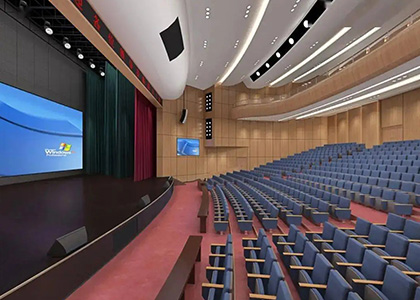
The auditorium is located in a certain courtyard, with a total floor area (audience area and stage area) of approximately 950 square meters, and a total planned seating capacity of approximately 600 seats in the audience area of the auditorium.
This project is a renovation project, and the demolition work has been basically completed. At present, the overall sound quality experience on site is poor, with obvious sound quality defects such as long reverberation time, echoes, and trembling echoes.
We will complete the architectural acoustic design for the renovation of the auditorium based on corresponding standards, starting from actual usage functions, combining theoretical calculations and practical engineering experience, and starting from optimizing the body shape, controlling the volume, and achieving the optimal listening environment.
2. Design basis
Architectural and structural design drawings provided by the owner;
The actual use function of the theater;
Code for Design of Theater Buildings (JGJ57-2016);
Code for Acoustic Design of Theaters, Cinemas, and Multipurpose Hall Buildings GB/T50356-2005;
National Standard of the People's Republic of China "Design Specification for Hall Sound Reinforcement System" GB50371-2006;
National standard of the People's Republic of China "Code for Fire Protection Design of Building Interior Decoration" GB50222-2017;
National Standard of the People's Republic of China "Environmental Noise Standard for Urban Areas" GB3096-2008;
Regulations on Indoor Environmental Pollution Control of Civil Building Engineering GB50325-2010;
A reference book on the acoustic performance of building acoustic materials (such as the "Acoustics Handbook").
3. Functional requirements
The auditorium is mainly used for large-scale meetings, gatherings, and presentations, as well as small-scale artistic performances. Specific requirements for building acoustic environment include:
Satisfy the audience with good listening conditions. When using a sound reinforcement system, the transmission of voice is clear and understandable, and the playback of music is full and bright.
The audience hall shall not exhibit sound quality defects such as echoes, trembling echoes, and sound focusing.
The background noise must be controlled within the standard limits.
The internal diffusion of the hall is good, and the natural sound field is uniform.
Acoustic indicators
According to national standards, the main indicators for measuring whether the acoustic environment of hall buildings is qualified include:
Reverberation Time(RT)
Reverberation time is one of the most important objective parameters for room sound quality. Its definition is the time required for the sound energy to decay by 60dB after the sound source stops producing sound. Referring to the requirements for acoustic design in the "Code for Acoustic Design of Theaters, Cinemas, and Multipurpose Hall Buildings" GB/T50356-2005, according to the requirements for the use of auditoriums and the volume of the auditorium, the full reverberation time at intermediate frequency (500-1000Hz) should be controlled at 1.0 ± 0.1s. Reverberation time frequency characteristics: relative to the ratio at 500Hz~1000Hz.
|
Frequency(Hz)
|
125
|
250
|
2000
|
4000
|
|
Ratio
|
1.0~1.3
|
1.0~1.15
|
0.9~1.0
|
0.8~1.0
|
Background noise
Meet the noise evaluation curve NR-35
Other acoustic indicators
Early decay time(EDT)
The early decay time is defined as the time required for the initial 10dB decay of the sound after the sound source stops. EDT is also one of the important parameters for evaluating the sound quality of halls.
Compared to RT, EDT has little to do with occupancy rate, at least in large halls (over 1500 seats). Compared to small halls, large halls rarely experience reflection of sound waves in the audience area during the initial 10dB decay time (approximately 200ms).
Clarity (sound energy ratio,C80)
The definition used to evaluate the clarity of music is the ratio of early sound energy (0-80ms) to late (reverberation) sound energy (80ms ~ ∞), which is:

C80 reflects the ratio of early sound to reverberation. If C80 is a large positive value, the concert sounds clear, but the room will be relatively quiet; On the contrary, if C80 is a large negative value, the reverb will be longer and the music will sound round but not clear. We hope to have different C80 values in different places. Given the functional positioning of the auditorium mentioned earlier, the audience area should have good clarity, and the C80 value should be greater than 3dB.
speech transmission index(STI)
The proposal of the Language Transfer Index (STI) method is based on the discovery in experiments that fluctuations in language signals carry information related to language clarity. The acoustic characteristics of words and sentences can cause fluctuations in language signals. These fluctuations are also fundamental components of language, called modulation, and can be expressed in terms of modulation frequency. To correspond to the speed of language, a typical modulation frequency ranges from 0.5 to 16 Hz. By calculating the amplitude reduction of the modulation frequency corresponding to each frequency band of the language spectrum, the modulation transition value can be obtained. Finally, the STI can be obtained based on the modulation transition value.
Simply put, the Language Transmission Index is an indicator that measures the quality of speech transmission. This parameter can comprehensively reflect the impact of reverberation time signal-to-noise ratio and echo on language clarity, and takes into account factors such as system distortion and psychoacoustic effects (masking effects). Its value range is 0-1, and a larger value indicates better clarity.
4. Acoustic design scheme
1. Body shape adjustment
The auditorium is a framed rectangular theater. In order to obtain a relatively rich lateral early reflection sound in most areas of the pool seat, it is advisable to set up octagonal walls on both sides of the stage entrance towards the audience area. The rich lateral pre reflection sound has great benefits for the audience's sense of presence and space.
The plane shape of the eight shaped wall is shown in the following figure, and the specific node size is determined by the decoration design.
The walls on both sides of the auditorium adopt a folding line diffusion design to avoid multiple back and forth reflections of sound caused by parallel walls, ensuring a uniform sound field in the audience area. The plane shape of the side wall in the audience area is shown in the following figure, and the specific node size is determined by the decoration design.

The ceiling of the auditorium adopts a layered diffusion structure. The light layout of the joint surface is generally divided into three diffusion surfaces. The rear end of the diffusion surface tilts upwards to ensure a good listening environment in the front and rear rows of the audience area. Combining the reasonable equipment pipeline space above the ceiling and the sound field diffusion requirements that the ceiling needs to meet, the average height of the audience area is controlled at around 7m after the completion of the ceiling. The approximate shape of the ceiling in the audience area is shown in the following figure, and the specific node size is determined by the decoration design.
By adjusting and optimizing the overall body shape, it is ensured that the sound field in the entire auditorium spreads well, has good sound field uniformity, and avoids the occurrence of serious sound defects.
2. Sound insulation and noise reduction design
To meet the requirements of NR-35 for medium background noise, the total sound insulation of the enclosure structure of the auditorium should not be less than 55dB.
The wall structure of the auditorium is all solid, and it is recommended to have a double-sided plastering of 2cm. The wall is not directly grooved, and all pipes and fire protection are concealed through decoration. With the addition of two decorative surfaces, the sound insulation level can basically meet 55dB. According to the principle of combined sound insulation, it is necessary to strengthen at entrances and exits with relatively weak sound insulation. There are mainly the following points:
All entrances and exits of the auditorium need to adopt a "sound barrier" structure, which is to use fire-resistant soundproof doors with a sound insulation level of no less than Rw-35, and the walls of the hallway between the doors should use sound-absorbing structures. Pay attention to the sealing of each door.
If air conditioning is involved in the renovation plan of the auditorium, silencers should be installed at the air conditioning vents (outlet and return), with a noise reduction of more than 45dB and a controlled air speed of no more than 2m/s. If the air conditioning unit is located near the auditorium, a vibration isolator should be installed at the base of the unit. The air outlet of the air conditioning fan is connected to the pipeline through a canvas interface to prevent the transmission of fan vibration through the pipeline. If the pipeline vibrates significantly, adjustable spring hooks should be considered during installation.
3. Sound quality design
In order to have a good listening experience inside the theater, we need to strictly control the reverberation time inside the theater to ensure the required listening clarity for the meeting.
Reverberation Design
The auditorium and auditorium have a capacity of approximately 4900m³, According to its requirements for multifunctional use, the design target values for reverberation time at each frequency point are approximately as follows:
|
Frequency(Hz)
|
125
|
250
|
500
|
250
|
2000
|
4000
|
|
Reverberation Time(s)
|
1.3
|
1.1
|
1.0
|
1.0
|
0.9
|
0.8
|
In order to achieve the reverberation time of the entire frequency range and meet the design objectives, it is necessary to plan the sound absorption performance of each wall material reasonably. Considering the usage environment, when selecting materials, the highest standards should be followed in terms of fire resistance, impact resistance, moisture resistance, mold resistance, and environmental performance.
Stage
To avoid microphone howling during meetings and gatherings using sound reinforcement systems, and to ensure a clear performance sound environment in the stage area, all side walls and walls in the stage area should be treated with strong sound absorption.
50mm thick finished aluminum strip seam sound-absorbing board is used, and a 100mm rear cavity modular installation is adopted.
The floor of the stage area is made of stage specific wooden flooring.
观众区
The walls on both sides and back of the auditorium are mainly made of 50mm thick finished aluminum seam sound-absorbing panels and full frequency reflective panels. Modular installation, with an environmental protection level not lower than E1, and a fire resistance rating of non combustible grade A.
The octagonal wall at the entrance adopts a 30mm wood veneer GRG full frequency reflective plate.
The side wall of the audience area adopts a 50mm thick finished aluminum strip seam sound-absorbing board, which is installed in a modular manner with a 100mm rear cavity. The rear wall of the audience area adopts a 50mm thick finished aluminum strip seam sound-absorbing board, which is installed in a modular manner with a 100mm rear cavity.
The ceiling of the audience area adopts GRG suspended ceiling according to the established height and diffusion shape. The detailed design of the decoration node is determined, and attention is paid to the planning of the location of the surface light bridge and the surface light maintenance channel.
It is recommended to use plastic flooring for the floor of the audience area.
To ensure that the reverberation time of the auditorium auditorium is similar in both empty (unmanned) and full (with a seating rate of over 80%) situations, seats with soft fabric backrests and perforated structures at the bottom of flipped seats should be used to ensure similar sound absorption in both occupied and empty states.
Control room area
Set up a control room in the front left area of the audience area. It is recommended to build the control room with gypsum board partitions and double layer double structure partitions. Observation glass is used on the side facing the stage.
The control room area should also ensure a good listening environment, especially for voice control rooms with return listening equipment.
It is recommended to use a 50mm thick finished aluminum strip seam sound-absorbing ceiling at the top of the control room, with a modular installation of the cavity after 100mm.
The bottom plate of the control room should use an anti-static raised floor. The recommended overhead height is 300mm.
The control room passage door adopts solid heavy wood doors or steel soundproof doors.
The control room glass window adopts double-layer soundproof glass and is arranged at an angle that is not parallel.
Computer simulation software simulation
This auditorium is mainly used for large-scale conferences, gatherings, and presentations, as well as for small-scale artistic performances. The design audience is approximately 600 people.
On the premise that the acoustic design specifies the sound quality technical indicators of the hall, necessary computer sound quality simulations are conducted to simulate the reverberation time after the decoration of the hall, ensuring that the auditorium can meet the expected design indicators. At present, the design target for intermediate frequency reverberation time in the hall has been determined to be 1.0 ± 0.1 seconds.
1) Establishment of acoustic models
When establishing a three-dimensional acoustic model of the auditorium, determine its three-dimensional Cartesian coordinate system according to the following principles. The coordinate origin is taken on one side of the stage curtain as the intersection point with the stage floor,. Facing the audience area from the origin is the positive direction of the X-axis, facing the audience seat from the origin, and the left is the positive direction of the Y-axis; The positive direction of the Z-axis is from above the origin.
Figure 1: Perspective view of the computer acoustic model of the auditorium
2) Sound source and acoustic analysis grid surface in the model
Arrange sound source points at the center of the stage entrance, with a height of 1.5m above the ground, to simulate the location of natural sound production. The acoustic analysis grid is selected as a plane parallel to the ground and 1.2 meters above the ground, simulating the height of the human ear. The grid accuracy is divided into one grid for every 1.5m * 1.5m area. The schematic diagram of the acoustic analysis grid position is shown in Figure 2.
Figure 2 Schematic diagram of acoustic analysis grid position
3) 3D acoustic ray tracing and acoustic reflection map of the model
It is possible to visually observe the true propagation process of sound lines or sound waves from three-dimensional sound line tracing and sound wave reflection maps. At the same time, it is possible to conduct water tightness testing on the three-dimensional model to ensure that it is a closed space and ensure the accuracy of computer simulation.
Figure 3 Schematic diagram of three-dimensional sound ray tracing
Figure 4 Schematic diagram of three-dimensional sound wave reflection
4)Layout of acoustic materials in the model
When using Odeon software for simulation calculations, it is necessary to assign a scattering coefficient to the acoustic materials on each surface, which represents the material's ability to scatter sound waves. When sound waves incident on the surface of a material, they undergo sound absorption, transmission, and reflection on the surface. A portion of the sound energy is absorbed by the material, while a portion passes through the material and reaches the surface of another medium. Finally, a portion of the sound energy is reflected. The reflected sound energy can be divided into two parts according to specular reflection and scattering (also known as diffuse reflection). Specular reflection follows the rule of three lines coplanar and two angles equal, while scattering follows Lambert's law of cosine. The materials selected for each surface in indoor sound quality computer simulation and their acoustic characteristics are shown in Table 2-1.
|
Table 2-1 Acoustic Characteristics of Main Materials on the Inner Surface of the Auditorium
|
|
Position
|
Material description
|
Sound absorption coefficient
(octave band)
|
|
125
|
250
|
500
|
1000
|
2000
|
4000
|
|
Stage area wall
|
50mm thick finished aluminum strip seam sound-absorbing board
|
0.42
|
0.84
|
0.87
|
0.88
|
0.81
|
0.58
|
|
Stage area ground
|
Stage specific wooden flooring
|
0.15
|
0.11
|
0.10
|
0.08
|
0.07
|
0.08
|
|
Stage area ceiling
|
Spray type fireproof spraying
|
0.12
|
0.10
|
0.09
|
0.07
|
0.05
|
0.07
|
|
Audience area side wall
|
50mm thick finished aluminum strip seam sound-absorbing board
|
0.42
|
0.84
|
0.87
|
0.88
|
0.81
|
0.58
|
|
Audience area side wall
|
30mm full frequency reflector
|
0.10
|
0.12
|
0.10
|
0.10
|
0.15
|
0.10
|
|
Rear wall of audience area
|
50mm thick finished aluminum strip seam sound-absorbing board
|
0.42
|
0.84
|
0.87
|
0.88
|
0.81
|
0.58
|
|
Audience area ceiling
|
Modeling board GRG
|
0.12
|
0.10
|
0.09
|
0.07
|
0.09
|
0.05
|
|
Audience area ground
|
PVC floor adhesive board
|
0.10
|
0.09
|
0.08
|
0.07
|
0.08
|
0.07
|
|
Audience area seats
|
Theater specific seats
|
0.46
|
0.68
|
0.74
|
0.66
|
0.68
|
0.62
|
|
Facial smooth mouth
|
Calculated according to coupling space
|
0.16
|
0.20
|
0.25
|
0.30
|
0.28
|
0.28
|
The internal view of the acoustic model is shown in Figures 5 and 6:
Figure 5 Interior view from one side of the stage towards the audience seat
Figure 6 Interior view of the stage area from the left rear of the audience area
5) Acoustic simulation results
Perform indoor sound quality computer simulation on the model, and divide the entire acoustic analysis grid into 1.5m × A 1.5m grid is divided, and a measuring point is arranged within each unit grid. The acoustic parameter values of the measuring points represent the acoustic parameters of all receiving points within the entire grid. This way, the distribution of various acoustic parameters within the entire grid can be obtained. The computer simulation results are shown in Figures 7 to 24.
A)Early decay time EDT

Figure 7 EDT distribution of early decay time in auditoriums (125Hz)

Figure 8 EDT distribution of early decay time in auditoriums (250Hz)

Figure 9 EDT distribution of early decay time in auditoriums (500Hz)

Figure 10 EDT distribution of early decay time in auditoriums (1000Hz)

Figure 11 EDT distribution of early decay time in auditoriums (2000Hz)

Figure 12 EDT distribution of early decay time in auditoriums (4000Hz)
B)Reverberation TimeT20

Figure 13 Distribution of Reverberation Time T20 in the Auditorium (125Hz)

Figure 14 Distribution of Reverberation Time T20 in the Auditorium (250Hz)

Figure 15 Distribution of Reverberation Time T20 in the Auditorium

Figure 16 Distribution of Reverberation Time T20 in the Auditorium

Figure 17 Distribution of Reverberation Time T20 in the Auditorium (2000Hz)

Figure 18 Distribution of Reverberation Time T20 in the Auditorium (4000Hz)
C)ClarityC80

Figure 19 Distribution of clarity C80 in the auditorium (125Hz)

Figure 20 Distribution of clarity C80 in the auditorium (250Hz)

Figure 21 Distribution of clarity C80 in the auditorium

Figure 22 Distribution of clarity C80 in the auditorium (1000Hz)

Figure 23 Distribution of clarity C80 in the auditorium

Figure 24 Distribution of clarity C80 in the auditorium
|
Table 2-2 Average values of auditorium sound quality parameters
|
|
Frequency/Hz
|
125
|
250
|
500
|
1000
|
2000
|
4000
|
|
Early decay time/s
|
1.41
|
1.31
|
0.81
|
0.78
|
0.77
|
0.82
|
|
Reverberation Time/s
|
1.30
|
1.05
|
0.99
|
0.93
|
0.95
|
0.93
|
|
C80
|
4.2
|
8.2
|
8.6
|
8.8
|
8.7
|
8.8
|
|
STI
|
More than 0.70
|
Figure 25: Average values of EDT and T20 parameters in the auditorium
6)Analysis of Simulated Result
By simulating the acoustic model of the auditorium and analyzing the acoustic parameters obtained from the simulation, some conclusions can be drawn. Here is a brief overview:
The mid frequency reverberation time in the auditorium is about 0.93~0.99 seconds, and the ratio of full frequency points to mid frequency reverberation time is within the standard specification limits. The reverberation time value in the entire frequency range is good. The value of the early attenuation time of the intermediate frequency is around 0.8 seconds, the clarity C80 intermediate frequency value is 8.1, and the language transmission index STI is greater than 0.70. These four values all indicate that the theater has high language clarity when natural sound (non directional sound source is placed in the center of the stage entrance) is present. In practical use, when using directional sound reinforcement systems (line arrays), language clarity will also be improved.
If considering music performances, electronic reverberation technology can be appropriately added to artificial reverberation to ensure the music richness required for music use.
From the grid distribution, it can be seen that except for a few corner positions, the distribution of the entire field is relatively uniform.
The sound-absorbing structure arranged in the hall is an important way to control reverberation time and has a direct impact on sound quality parameters such as reverberation time. Therefore, large area materials (such as seats, sound-absorbing panels, etc.) and key parts (such as soundproof doors, silencers, etc.) need to provide professional acoustic measurement reports and send samples for testing to ensure their acoustic performance before entering the site.
During the decoration design stage and the preparation stage of decoration construction, disclosure work should be arranged between the decoration profession and the acoustic profession to ensure that the decoration profession understands the relevant acoustic principles and processes of acoustic design, in order to ensure that the acoustic sound quality of the auditorium reaches the expected effect.



 Contact