Publisher: Guangzhou Chuangya Acoustics Technology Co., Ltd. Time: 9/9/2022 12:02:04 PM

A cinema is a place where movies are shown to the audience. It is composed of auditorium, public area, projection room, and other rooms (including VIP reception room, building equipment room, intelligent system room, etc.). The architectural acoustic design of the cinema is an indispensable part of eliminating the acoustic focus, flutter echo and multiple echoes in the auditorium, reducing the acoustic interference of noise on the sound reinforcement system, and creating a good audio-visual effect. The acoustic design of cinema mainly includes the contents and requirements of reverberation control, sound insulation design, noise control, etc.
Cinemas can be divided into ordinary channels, stereo channels, four channels and six channels.
Cinemas can be divided into large, large, medium and small ones according to their capacity.
| Classification | Total seats | Number of auditorium |
| Extra large cinema | Over 1801 | Over 11 |
| Large cinema | 1201~1800 | 8~10 |
| Medium cinema | 701~1200 | 5~7 |
| Small cinema | Below 700 | Below 4 |
According to JBJ 58-2008 Code for Design of Cinema Buildings, the quality standards of cinemas are divided into four grades: special, first, second and third.
1、《Code for acoustical design of theaters, cinemas and multipurpose halls》(GB/T 50356-2005)
2、《Code for Design of Cinema Buildings》JBJ58-2008
3、《Technical requirements for audio-visual environment of cinemas》GB/T 3557-94
4、《Acoustic environment quality standard》(GB 3096-2008)
5、《Code for design of hall sound reinforcement system》(GB 50371-2006)
6、《Specification for reverberation time measurement in auditorium》GBJ76-84;
7、《Building sound insulation and absorption structure》(National Building Standard Design Atlas 08J931)
8、《Code for indoor environmental pollution control of civil construction engineering》(GB50325-2001)
9、《Code for Fire Protection Design of Buildings》GBJ16-1987(2001)
10、《Code for fire protection design of interior decoration of buildings》(GB50222-95)
11、《Code for design of sound insulation of civil buildings》GB 50118-2010
12、《Technical specifications for digital stereo cinema》GY/T 183-2002
13、Star rating requirements for cinemas - SARFT
14、《Evaluation standard for green buildings》GB/T 50378-2006
(1)Specification requirements
《Code for Design of Cinema Buildings》JBJ58-2008, It is stipulated that the frequency characteristics of the reverberation time in the auditorium of the special, class A and class B cinemas shall comply with the provisions in the following figure
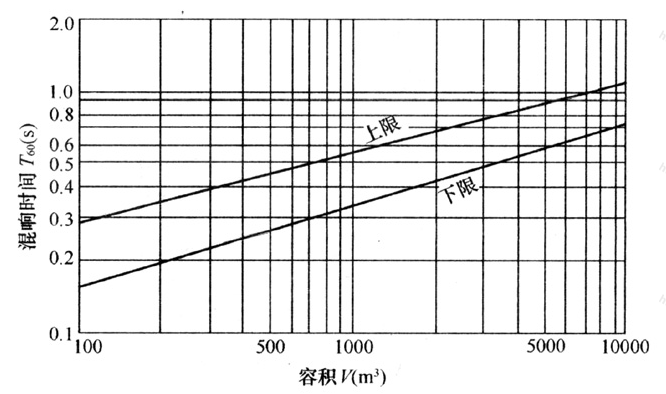
《Technical requirements for audio-visual environment of cinemas》GB/T 3557-94
|
|
Mono auditorium | Stereo auditorium | ||
| Volume(m³) | 500~2000 | over 2000 | 500~2000 | over 2000 |
| 500Hz Reverberation time(S) | 0.5~0.8 | 0.8~1.2 | 0.4~0.6 | 0.6~1.0 |
Ratio of reverberation time of each frequency to 500Hz
| Frequency(Hz) | Reverberation time ratio |
| 125 | 1.0~1.4 |
| 250 | 1.0~1.5 |
| 1000、2000 | 1.0 |
| 4000 | 0.8~1.0 |
Frequency Characteristics of the Reverberation Schedule in the Audience Hall of Special, Grade A and Grade B Cinemas
| Frequency(Hz) | 63 | 125 | 250 | 500 | 1000 | 2000 | 4000 | 8000 |
| Ratio | 1.00~1.75 | 1.00~1.50 | 1.00~1.25 | 1.00 | 0.85~1.00 | 0.70~1.00 | 0.55~1.00 | 0.40~0.90 |
《Code for acoustical design of theaters, cinemas and multipurpose halls》(GB-T 50356-2005)
500~1000Hz reverberation time of cinema auditorium
| Volume(m³) | IF reverberation time(S) | |
| Common | Stereo | |
| <1000 | 0.6~0.8 | 0.48~0.65 |
| 1000~6000 | 0.7~1.1 | 0.52~0.85 |
| 6000~10000 | 0.85~1.15 | 0.63~0.9 |
Ratio of reverberation time of each frequency in cinema auditorium to 500-1000Hz
| Frequency(Hz) | 125 | 250 | 2000 | 4000 |
| Ratio | 1.0~1.2 | 1.0~1.1 | 0.9~1.0 | 0.8~1.0 |
《Technical specifications for digital stereo cinema》GY/T 183-2002
Ratio of reverberation time of each frequency to 500Hz
| Frequency(Hz) | 63 | 125 | 250 | 1000 | 2000 | 4000 | 8000 |
| Reverberation time ratio | 1.0~1.5 | 1.2 | 1.0~1.1 | 1.0 | 0.8~1.0 | 0.7~1.0 | 0.6~0.9 |
(2)Solution
1、Cinema architectural design shall include acoustic design, which shall run through the whole process of cinema design.
2、The back wall of the auditorium shall adopt a full band strong sound absorption structure that prevents echo. Its average coefficient shall not be less than 0.6s within the range of 125~4000Hz, and the sound absorption coefficient at 125Hz shall not be less than 0.4.
3、The wall behind the silver screen shall be subject to sound absorption treatment.
4、Sound absorbing materials shall be reasonably arranged according to the shape of other walls.
5、The area and type of sound absorbing materials shall be reasonably arranged for the ceiling according to the cinema level.
6、Reasonably select seats (fully consider seat materials and noise pollution).
7、The seats with good stereo effect cover more than 2/3 of all seats.
(1)Prescribed requirements
《Code for acoustical design of theaters, cinemas and multipurpose halls》(GB-T 50356-2005)
Noise limit in auditorium
| Type of auditorium | Natural sound | Adopt sound reinforcement system |
| Mono ordinary cinema | - | NR-35 |
| Stereo cinema | - | NR-30 |
《Technical requirements for audio-visual environment of cinemas》GB/T 3557-94
Background noise
| Mono | Stereophonic channel |
| Suitable for ≤40dB(A) | Suitable for ≤35dB(A) |
| theoretically ≤45dB(A) | theoretically ≤40dB(A) |
《Noise emission standard for social living environment》(GB22337-2008) regulations
Noise emission limit at the boundary of social life noise emission sources
| Time interval | Daytime dB(A) | At night dB(A) |
| 0 | 50 | 40 |
| 1 | 55 | 45 |
| 2 | 60 | 50 |
| 3 | 65 | 55 |
| 4 | 70 | 55 |
|
Class 0 functional area is applicable to special residential areas, such as senior residential areas, sanatoriums, etc. The Class 1 functional area is applicable to the areas dominated by residential, cultural and educational institutions. Class 2 functional area is applicable to residential, commercial, industrial mixed area and commercial center area. Class 3 functional areas are applicable to industrial areas. Class 4 functional areas are applicable to areas on both sides of trunk roads. |
||
《Code for design of sound insulation of civil buildings》GB 50118-2010
| Room Type | Noise reduction coefficient(NRC) | |
| High requirement standard | Bottom limit standard | |
| Restaurants, fitness centers, entertainment venues | ≥0.80 | ≥0.40 |
Standard for airborne sound insulation of partition walls and floors between noise sensitive rooms and noise producing rooms.
| Enclosure name | Rw + Cu | |
| High requirement standard | Bottom limit standard | |
| Partitions and floors between fitness centers, entertainment places and noise sensitive rooms | ≥60 | ≥55 |
Impact sound insulation standard for the top floor of noise sensitive rooms
| Floor | Single value evaluation quantity of impact sound insulation(dB) | |||
| High requirement standard | Bottom limit standard | |||
|
Weighted normalized impact sound pressure level (experimental measurement) |
Weighted normalized impact sound pressure level (field measurement) |
Weighted normalized impact sound pressure level (experimental measurement) |
Weighted normalized impact sound pressure level (field measurement) |
|
| Floor slab between fitness center, entertainment place and noise sensitive room. | ≥45 | ≥45 | ≥50 | ≥50 |
(2)Resolvent
1、When the auditorium roof project adopts light roof, sound insulation and vibration reduction measures shall be taken.
2、Elevator or escalator should not be set in the cinema close to the auditorium. When it is set next to each other, measures such as sound insulation and vibration reduction shall be taken.
3、All kinds of rooms shall be arranged in different zones according to their noise levels. The noisy rooms should not be set adjacent to the auditorium. When it is set next to each other, noise elimination, sound insulation and vibration reduction measures shall be taken. For example, boiler room or cooling tower should not be set next to the auditorium; When it is set next to each other, noise elimination, sound insulation and vibration reduction measures shall be taken.
4、The auditorium should use the rest hall, lobby, corridor and other public spaces as sound insulation and noise reduction measures, and the entrance and exit of the auditorium should be equipped with sound gates.
5、Select low noise air conditioning system and ventilation system. Take corresponding measures to prevent the series connection between offices. The air conditioning or ventilation system shall adopt noise reduction and vibration isolation measures. The noise transmitted to the auditorium through the air outlet is 5dB lower than the allowable noise in the auditorium.
6、The wall of the auditorium shall not be perforated, and all pipes that need to go through the wall shall be sealed. The power sockets on both sides of the wall shall be staggered and the sound insulation measures shall be the best.
7、The partition between the auditorium and the projection room shall be sound insulated, and the sound insulation of intermediate frequency (500 ~ 1000Hz) shall not be less than 45dB.
8、The sound insulation between adjacent auditoriums shall not be less than 50dB at low frequencies and 60dB at medium and high frequencies.
9、The sound insulation of the sound insulation door in the auditorium shall not be less than 35dB. Sound absorption and noise reduction shall be carried out in the space with sound barrier.
10、All air-conditioning rooms, ventilation rooms, refrigeration rooms, water pump rooms, power transformation and distribution rooms, lighting control rooms, etc. must be well treated for sound absorption and noise reduction, sound insulation and vibration reduction. The sound insulation and vibration reduction capacity shall make the noise transmitted to the auditorium 5dB lower than the allowable noise in the auditorium.
1、Materials for interior decoration of auditorium shall be selected to prevent interference with light, and non reflective finishing materials shall be selected;
2、Corner matt black or dark decoration materials shall be adopted for screen frame, screen back wall and nearby side wall, and ceiling in front of screen, and matt black or dark decoration materials shall be adopted for platform opening, large screen and along screen;
3、The ground of projection room should be made of anti-static, dust-proof, wear-resistant and easy to clean materials;
4、The seat step structure in the auditorium shall be made of incombustible materials;
5、The ceiling materials in the auditorium, sound barrier and evacuation passage shall be Grade A decoration materials, and the wall and floor materials shall not be lower than Grade B1;
6、Class A materials shall be used for sound absorption, heat insulation, thermal insulation materials and maintenance catwalks in the suspended ceiling of the auditorium;
7、The projection room shall be separated from other parts by partition walls with a fire resistance rating of no less than 2.0h and floor slabs with a fire resistance rating of no less than 1.5h. The ceiling decoration materials shall not be lower than Grade A, and the wall and floor materials shall not be lower than Grade B1;
8、The keel materials used for the ceiling and wall decoration of the cinema shall be Grade A materials;
9、The ceiling of the smoking room in the cinema shall be made of Class A materials, and the floor and wall shall be made of materials no less than Class B1 materials;
10、The number of evacuation doors in the auditorium shall be determined by calculation and shall not be less than 2. It shall not be less than 0.90m. Class A fireproof door shall be adopted.

 Contact
400-1593-886
Room 506, Huachang Center, Nanhai District, Foshan City, Guangdong Province
Scan the code and follow the WeChat public account

Add WeChat customer service