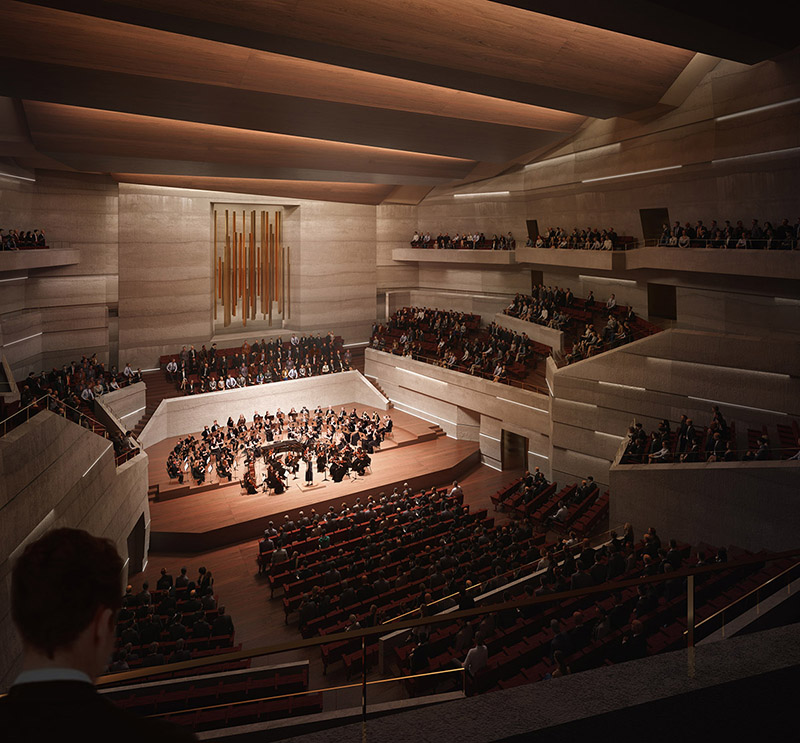
The stage entrance of the concert hall plays an important role in obtaining early reflected sound for the middle seats in front of the pool seats in the hall. The reflecting surface composed of the front side wall and the top plate of the abutment shall be designed for the reflected sound obtained in the front and middle area of the pool seat, which is irreplaceable by other interfaces in the hall.
Apron and box breast board
The concert hall usually takes into account the two forms of natural sound and sound reinforcement performance. The sound source is located at two different positions on the stage (natural sound) and the sound bridge (loudspeaker group of sound reinforcement system) above the proscenium. The concert hall absorbs sound. The balcony balustrade is usually concave and curved, and the concert hall is sound-absorbing. Therefore, diffusion design shall be made on the breast board, which can be in the form of convex arc-shaped circular wall, triangle, cone, etc.
Ceiling under the tower
Seats under the balcony are usually far from the stage. In order to obtain uniform sound field distribution, under the condition of natural sound performance, flowering should play a role in strengthening the sound intensity of the backseat; When sound reinforcement is adopted, the ceiling shall enable the sound of the loudspeaker group to enter the space under the tower smoothly.
Back wall of music venue
The decoration of the back wall of the concert hall shall be determined according to the use function and performance mode of the hall. For concert halls and opera houses with natural sound performance, the back wall should be subject to sound reflection and diffusion treatment. For halls with sound reinforcement systems, sound absorption structures can be selected. At the same time, it is necessary to prevent echo generation and the decoration of loudspeaker groups. The decoration structure of loudspeaker groups in music venues should meet the requirements of sound transmission and aesthetics.
(1)The finish structure must have the maximum sound transmission rate, which shall not be less than 50%;
(2)The lining horn cloth shall be as thin as possible to avoid affecting the output of high-frequency sound;
(3)The structure must have enough stiffness to avoid resonance;
(4)When the wood grid veneer is used, the width of the wooden strip shall not be greater than 50mm to avoid blocking the output of high-frequency sound.

 Contact